The author struggles with Cursors agent waiting for a "Run terminal Command" and uses xcode as he does not trust Cursor's AI not to corrupt his xcode project.
Below is the final version of the Substack article (with the integration test details and all suggested improvements) followed by a comprehensive Mermaid workflow diagram to visually capture the entire process.
A Case for Human Relevancy and Involvement in an Ever-Changing AI World
I recently embarked on an unexpected journey using Cursor AI to build an iOS app in Swift—even though I’ve never been an iOS developer before. In just one week, Cursor transformed my understanding of Swift, debugging, and feature-driven project planning. This experiment became my proving ground—a testbed to sharpen my skills before diving into more complex, LangChain-based applications in eCommerce. Not only did this exploration justify my $99 Apple Developer License, but it also redefined my approach to AI-assisted development.
The Journey & the Challenges
From day one, excitement fueled my efforts. I rapidly assembled a working codebase and a unique app concept designed to innovate within the iOS ecosystem. Yet, the road was anything but smooth. I encountered baffling errors such as:
Error acquiring assertion: <Error Domain=RBSAssertionErrorDomain Code=2 "Assertion's invalidation time is in the past" UserInfo={...}>Along with persistent quirks—like the recurring // MARK: - Error Definitions—I learned that even minor changes to critical files (such as the .pbxproj) can derail the project. The lesson? Commit stable builds frequently!
The Coordination Trifecta
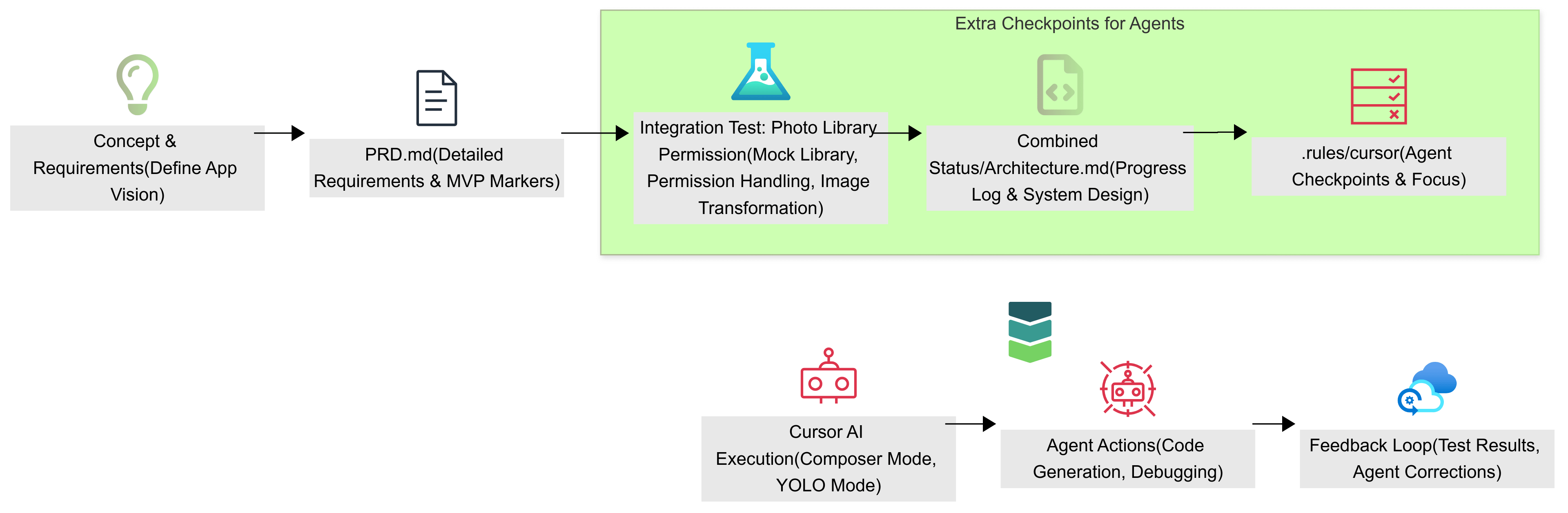
To navigate these challenges, I adopted a structured framework consisting of three core artifacts:
1. PRD.md:
A comprehensive requirements document with clearly marked [MVP] sections for AI agents. This file outlines feature goals and key use cases.
2. Combined Status/Architecture.md:
A live log that doubles as progress tracking and system design documentation. One standout example was the integration test for the iOS app’s photo library permission. The app needed to request permission to access the photo library, create a mock library, handle permissions, and then apply transformations to an image. Documenting this as an integration test first in architecture.md was both mind bending and immensely satisfying—especially when the changes persisted seamlessly across agent sessions.
3. .rules/cursor:
A dedicated artifact designed to keep agent workflows focused. This file acts as a set of checkpoints (or breadcrumbs) for the agents, much like code markers (e.g., // MARK: - Error Definitions), ensuring that future agents have a clear trail to follow.
Emerging Frameworks & The Road Ahead
Cursor’s seamless integration has been invaluable, yet my journey is evolving. Inspired by modular architectures detailed in LangChain’s documentation, I’m now exploring frameworks like LangGraph. These emerging tools promise enhanced orchestration by modeling inter-agent relationships more robustly. Imagine the next time Cursor’s agents misinterpret my Swift code and automatically execute npx create-next-app@latest—a LangGraph-enhanced system might not only detect the error but self-correct in real time.
This iOS/Swift experiment is just the beginning—a testbed that sharpens my skills before building the complex, LangChain-based eCommerce applications I envision. It’s a stepping stone toward a future where dynamic traffic management, automated daily chores, and proactive health detection become realities.
A Voice from the Field
As succinctly noted by Kasey at Gulp.ai:
“The current improvement loop for AI, with human intervention, is manual and time-consuming. What’s become abundantly clear to us is that human data should no longer be the gold standard now that models are able to self-improve. A more elegant approach would be to merge inference costs with training costs, and simply train AI on its own outputs to move towards real-time responsiveness.
Right now is an especially exciting time to be working on software, and we think what’s being done with real-time data (across consumer, fintech, AI, and more) is just the beginning.
We’re captivated by the concept of a future full of responsive software. Where dynamic traffic lights and routing alleviate city congestion. Where daily chores can be automated without manual prompting. Where proactive detection of health concerns can save lives.
We want to make that future a reality.”
— Kasey, Gulp.ai
This validation lends strong credence to the visionary future we’re collectively working toward—even as the research strengths of tools like Osmosis (leveraging vector databases) remain coupled with the need for robust human oversight and extra “breadcrumbs” to keep agents on track.
A Call to Innovators
If you’re working with LangChain in the eCommerce space or exploring how AI can revolutionize commerce, please reach out—I’d love to connect and explore collaborative opportunities in this exciting intersection.
The Vision
The key takeaway is clear: For large AI teams working on the same codebase, robust coordination is indispensable. We must enforce a trifecta of clear documentation—agent rules, PRD.md, and a combined status/architecture log—to ensure that as AI agents learn and evolve, human oversight remains our guiding star.
Until tools like Osmosis and emerging frameworks like LangGraph evolve to not only research but also effectively coordinate agent activity in real time, human intervention remains critical. As we continue to innovate—one bug, one error message, one git commit, and one breakthrough at a time—the future of AI-assisted development hinges on blending human creativity with advanced orchestration frameworks. This journey, which began with an iOS/Swift testbed, is just the beginning.
Comprehensive Mermaid Workflow Diagram
Below is a detailed Mermaid diagram capturing the entire workflow—from initial requirements through integration testing and final orchestration. This visual guide is designed for those who prefer a graphical overview:
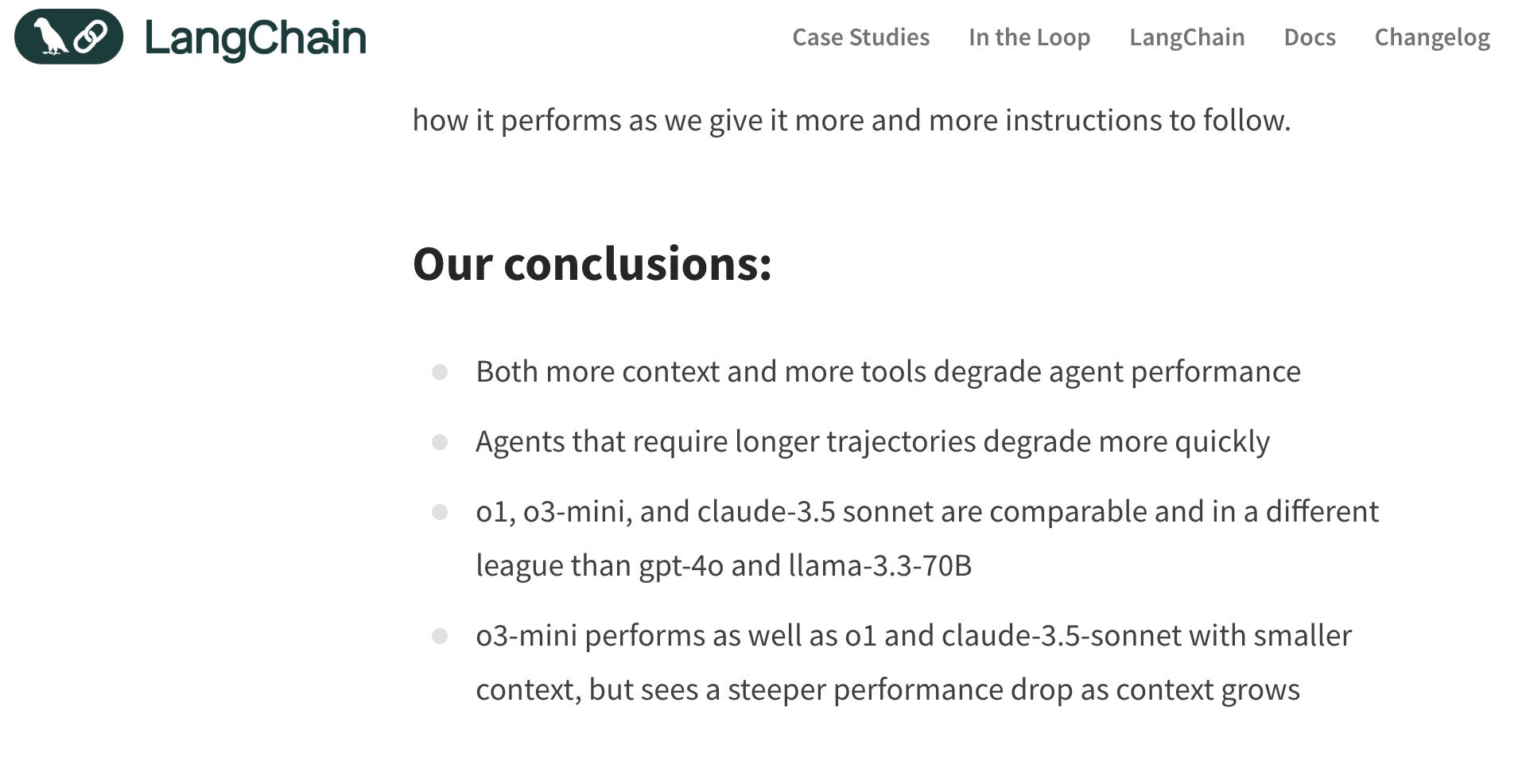
Update February 12: If this area interests you, Langchain just posted their impressions of a single agent benchmark over time - As things stand right now, agents in general see degradation over time, highlighting roles of humans to keep things fresh